Pattern · seen in 3 breakdowns across 2 companies
Atomic Phases
Atomic phases means splitting a long job into steps that each save their result when they finish, so an interrupted job resumes from the last finished step instead of starting over or repeating work.
The mechanism
The pattern at its core: a job split into a few steps, each one saving a checkpoint when it finishes, and a retry that reads those checkpoints to pick up where it left off.
Crash a workflow partway, then retry - resume from the last checkpoint, or restart from zero and charge the card twice.
Definition
Break a long job into separate steps, each able to finish and be saved on its own, so that if the job is interrupted it can pick up from the last saved point without redoing or skipping work. Each phase has three parts:
- a clear input, so it knows what it starts from
- one real change to the outside world, such as charging a card or saving a record, kept to that one change or a small set of closely related ones
- a saved marker that records it finished
When the job retries, it reads what was saved, sees which phase finished last, and carries on from the next one. A long operation that reaches across the network becomes a line of small steps you can think about one at a time - each free to succeed, fail, or run again on its own without breaking the rest.
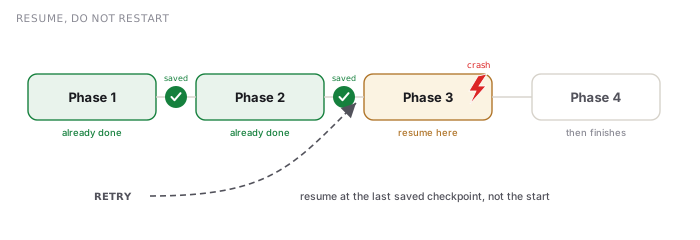
The rule that makes it work: each phase is all-or-nothing as far as the outside world can see. Either the phase finished and its result is there for the next phase, or it didn't and the next try sees the world exactly as it was before the phase started. Nothing half-done is ever visible.
When it applies
Tradeoffs
The same move, 3 ways
Every row is a production system that bet on this pattern — the note says how, in that system's own terms.
Often used together
Patterns sharing breakdowns with this one — derived from co-occurrence, threshold ≥2 shared.
Problems this pattern answers
The walls where its breakdowns live — each opens the cross-company comparison.