Cell Architecture

resilience

Definition

Cell architecture organizes a distributed system as a set of independent, self-contained units (cells), each of which can fully serve a subset of the workload on its own. Cells share no critical state with each other; a failure in one cell does not propagate to others. Capacity scaling happens by adding cells rather than by growing individual cells beyond their designed size. Each cell typically combines multiple infrastructure components (compute, storage, queueing, routing) into a complete service unit, and is sized small enough to be operationally manageable as a single coherent system.

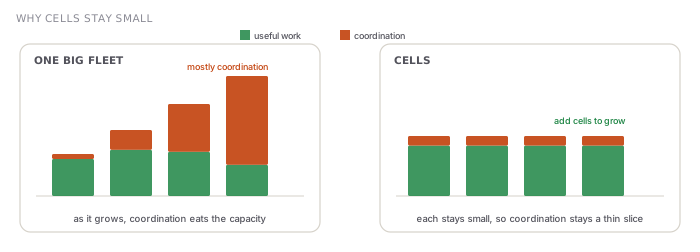
The motivating insight is that systems built as 'one large fleet' eventually hit a coordination overhead wall. As fleets grow, the work of keeping the fleet in sync — leader elections, gossip protocols, configuration distribution, schema migrations — grows faster than the fleet's serving capacity. The fleet starts spending an increasing fraction of its resources on coordination rather than serving requests. Cell architecture caps this overhead by ensuring no single cell ever grows large enough to hit it. The system as a whole scales horizontally by adding cells; individual cells stay manageably small.

A second insight is failure isolation. In a one-large-fleet design, a bad deploy, a poisoned cache, a corrupted index, or a misbehaving tenant can affect every customer. In cell architecture, the same problem affects only the cell that hosts it. The blast radius of any single failure is bounded by the cell's tenant set. This is especially valuable when failures correlate with specific tenants (a hot partition key, an unusually expensive query pattern, a request volume spike from one customer) — the cell containing that tenant absorbs the impact while other cells continue normally.

Cells can be specialized when not all tenants have the same characteristics. Discord's 2025 architecture has separate cells for guild messages, user DMs, and 'Big Freaking Guilds' — each cell's configuration is tuned for its workload. AWS, Slack, and Salesforce all run variations of cell architecture in production, with cells differing in capacity, isolation level, and tenant assignment policy. The common thread: cells are the unit of capacity, the unit of isolation, and the unit of operational reasoning.

When it applies

  • Multi-tenant systems at the scale where 'one large cluster' has accumulated enough coordination overhead that adding more capacity to the existing fleet produces diminishing returns
  • Systems with mixed-workload tenants where some characteristics (very large tenants, regulatory-sensitive data, premium SLAs) deserve dedicated infrastructure that would be wasteful as a per-cluster guarantee but works well as a per-cell guarantee
  • Architectures where failure isolation between tenant cohorts matters operationally — when an incident affecting cell A is acceptable but an incident affecting the entire customer base is not
  • Operational contexts where the team wants to perform infrastructure-level changes (software upgrades, configuration changes, capacity additions) on a per-cell basis, with the ability to validate each change on one cell before propagating to others
  • Systems handling sustained growth where individual components have known scaling limits (a single Elasticsearch cluster's master node, a single database's connection pool, a single Kafka topic's partition count) and the chosen design is to multiply rather than enlarge those components

Tradeoffs

  • Operational surface area multiplies. A fleet of N large clusters becomes M*N smaller clusters when reorganized into cells. Each cell needs monitoring, alerting, capacity planning, and operational tooling. The benefit is that each cell stays simple; the cost is that the team must operate many cells in parallel rather than one large fleet in depth.
  • Cross-cell operations become expensive. Queries that need to fan out across cells (cross-tenant analytics, global search, system-wide reporting) require either a separate aggregation layer or an architectural decision to give up that capability. Cell architecture works best when the workload genuinely partitions cleanly; less well when natural query patterns span cells.
  • Tenant placement becomes a design problem. How do you decide which tenants go in which cell? Random assignment is fair but may not balance load; deliberate placement based on tenant characteristics gives better outcomes but requires sustained editorial work. Tenant migration between cells (when a tenant outgrows its current cell) is an additional engineering surface area.
  • Resource utilization can suffer if cells are sized for peak load. A small cell handling a small tenant set has less headroom for traffic spikes than a large fleet with averaged load. The team accepts higher steady-state cost for the failure-isolation properties, but this is a real cost that monolithic architectures don't pay.

Seen in

  • Discord EngineeringApr 24, 2025

    How Discord Indexes Trillions of Messages

    The 2025 redesign's grouping of smaller Elasticsearch clusters into logical cells, each dedicated to a specific use case (guild messages, user DMs, Big Freaking Guilds). The architectural unit shifts from 'cluster' to 'cell of clusters,' which provides failure isolation at a more useful granularity and enables per-use-case optimization. Discord's cell architecture is one of the cleanest published examples — the cells are visible in the architecture, the use cases are distinct, and the BFG cell is a textbook 'one cell per outlier class' implementation.

  • Slack EngineeringAug 22, 2023

    The Drain Button: Slack's Migration to a Cellular Architecture

    Slack's cells are availability zones: every service present in every AZ, no service talking across AZ boundaries, so each AZ is an independently drainable unit. The recurrence with Discord — whose cells are small Elasticsearch clusters behind application routing — is the pattern proving its generality: the cell is whatever unit you can afford to lose, sized so that losing it is routine.