Pattern · seen in 3 breakdowns across 3 companies
Embedded vs Centralized Orchestration
Embedded vs centralized orchestration is where coordination lives: inside each service as a library (isolated, but hard to span services), or in one shared cluster (easy, but a single point of failure).
The mechanism
The pattern at its core: the same coordination logic arranged two ways - inside each service, or in one shared cluster - and the opposite trades that fall out of that single choice.
Run three scenarios across both shapes and watch the trade flip - centralized wins coordination, embedded wins isolation.
Definition
When a system has to coordinate work across several steps - running workflows, retrying, scheduling - there are two ways to arrange it, and they make opposite trades:
- embedded - the coordinating logic runs inside each service, as a library it imports; each service stays independent, but coordinating across services is hard
- centralized - the logic runs as one shared cluster every service calls over the network; cross-service coordination is easy, but every service now depends on that one cluster
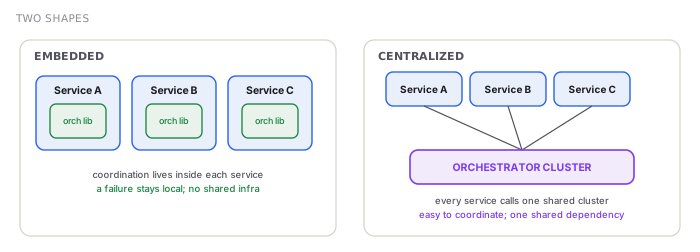
The embedded shape ships as a library. Each service runs its own coordination in-process and keeps the state in the database it already has. If one service's coordination breaks, no other service is touched, and there is no new system to run. The cost is that workflows spanning several services get much harder: you either wire the coordination together by hand, or you accept that each workflow stays inside a single service.
The centralized shape ships as a separate cluster. Every service calls that cluster over the network, and the cluster holds the workflow state and coordinates the steps across services. You get one dashboard for all workflows, support for many languages, and cross-service coordination that just works. The cost is that every service now depends on that cluster staying up, and the cluster becomes a critical thing your team has to tune, scale, and protect. The shared cluster becomes a single point of failure.
Which one wins usually comes down to two questions: do your most important workflows stay inside one service, or span across many services, and can your team take on the work of running a shared cluster?
When it applies
Tradeoffs
The same move, 3 ways
Every row is a production system that bet on this pattern — the note says how, in that system's own terms.
Often used together
Patterns sharing breakdowns with this one — derived from co-occurrence, threshold ≥2 shared.
Problems this pattern answers
The walls where its breakdowns live — each opens the cross-company comparison.