Fault Isolation

resilience

Definition

Fault isolation is the architectural practice of containing failures so that one component's degradation doesn't cascade into others. The defining mechanism is making explicit the boundaries between components and ensuring those boundaries hold under failure — through dedicated resources, separate data paths, independent failure domains, or sandbox-style containment.

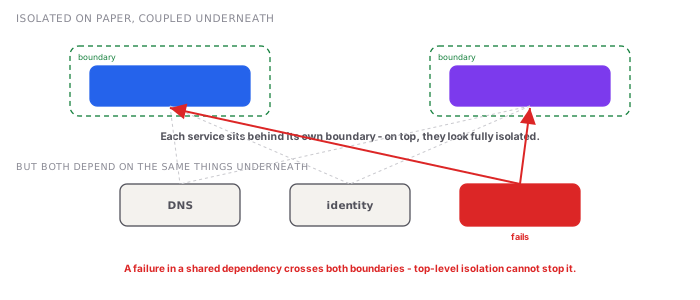
The core insight is that systems naturally develop shared dependencies as they grow, and those shared dependencies become the conduits through which localized failures become systemic outages. Fault isolation reverses the default: instead of sharing infrastructure for efficiency and discovering shared failure modes during incidents, you deliberately accept resource duplication or operational overhead in exchange for guaranteed containment.

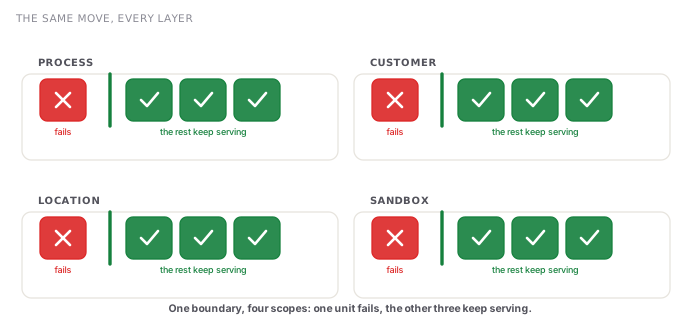
Fault isolation can be applied at many layers: process isolation (each service in its own container), tenant isolation (each customer's data and resources separated), failure-domain isolation (across availability zones, regions, or providers), traffic isolation (separate network paths for different traffic classes), or capability isolation (sandboxed code with limited permissions). The same principle scales across these layers because the underlying logic — failure should not propagate beyond the boundary that contains it — is universal.

When it applies

  • Designing infrastructure where a failure in one component could cascade through shared dependencies into a broader outage
  • Multi-tenant systems where one tenant's behavior must not degrade service quality for others (noisy-neighbor protection)
  • Building safety or observability systems that must continue to function when the systems they oversee are failing
  • Running untrusted or auto-generated code where the host system must survive arbitrary behavior in the guest
  • Operating at scale where shared-resource utilization optimization has crossed into shared-failure-mode territory

Tradeoffs

  • Resource duplication is the cost: isolated systems use more compute, more network, more storage than a shared equivalent. The economics only work above a certain scale or stakes threshold.
  • Operational complexity increases: separate systems mean separate deployment, separate monitoring, separate runbooks. Each isolated boundary is also a coordination boundary that human teams must manage.
  • Boundaries can be subtle. A system can appear isolated while sharing hidden dependencies (DNS, control plane, identity, secrets infrastructure). Fault isolation requires actively mapping and severing every shared dependency that matters, not just the obvious ones.
  • Over-isolation creates its own problems: too many independent failure domains can fragment debugging, slow down legitimate cross-cutting changes, and concentrate complexity at the boundaries. The right granularity depends on what failure modes you're actually trying to contain.

Seen in

  • Airbnb EngineeringMay 5, 2026

    Monitoring Reliably at Scale

    Every layer of Airbnb's redesign embodies fault isolation: dedicated compute clusters isolate the metrics pipeline from app workloads, a separate Envoy L7 plane isolates telemetry traffic from business traffic, and the Dead Man's Switch isolates failure detection from the failing system. The same principle applied at three different layers.

  • Discord EngineeringApr 24, 2025

    How Discord Indexes Trillions of Messages

    Cell architecture is fault isolation at the cluster-group level. A failure in the BFG cell doesn't affect the user-dm-messages cell. A bad deploy of routing logic for guild messages doesn't impact DM search. The 2025 redesign sets up a hierarchy of isolation boundaries (cluster, cell, use case) that the original two-cluster architecture couldn't express. This is the same pattern Airbnb applies in their monitoring infrastructure, now applied at a different layer.

  • Service-Level Prioritized Load Shedding

    The article is a study in choosing the cheapest sufficient isolation. Physical sharding is the strongest fault isolation (separate clusters, hardware-enforced) but most expensive; the partitioned limiter trades hardware isolation for logical isolation at one cluster's cost, accepting that the boundary is now software the team must keep correct. A worked example of fault isolation as a spectrum with a cost gradient, not a binary.

  • Slack EngineeringAug 22, 2023

    The Drain Button: Slack's Migration to a Cellular Architecture

    Siloing converts an AZ from a slice of every request's fan-out into a contained failure domain: a failure inside one AZ presents errors only in that AZ's frontends, instead of surfacing in all of them. The June 30 incident is the pattern's negative proof — pre-cellular, one link's gray failure was everyone's outage.

  • Shopify EngineeringJul 28, 2022

    Ten Bounds on Failure: Resilient Payment Systems at Shopify

    The country-scoped circuit breaker identifiers are failure-domain partitioning at the granularity of a payment gateway's local acquirers — one region's outage is contained instead of propagating through a shared global circuit.

  • The GitHub BlogSep 27, 2021

    Virtual Before Physical: Partitioning GitHub's Relational Databases

    The availability half of GitHub's motivation is blast radius: any incident on mysql1 degraded every core feature at once. Partitioning by schema domain shrinks the shared-fate domain — an incident on one cluster now touches one feature family — which the post credits, alongside the load reduction, for the significant drop in database-related incidents.