Pattern · seen in 3 breakdowns across 3 companies
Generic Mitigation
A generic mitigation is a safe, reversible action that reduces the damage for many kinds of failure, so you can apply it before you even know what caused the incident.
The mechanism
The pattern at its core: an incident whose cause is still unknown, and a choice between debugging for the cause first or applying a safe, reversible mitigation right away.
Meet an incident of unknown cause - diagnose first, or mitigate on suspicion, and watch the user impact shrink.
Definition
A generic mitigation is a fix you can apply before you know the root cause: something that reduces the damage across a whole range of failures, is safe to try, and is cheap to undo. A good one has four properties:
- fast - it takes effect quickly, before the outage does too much damage
- harmless - it adds no errors of its own, so trying it can't make things worse
- gradual - you can turn it on a little at a time and watch whether things recover
- independent - it doesn't rely on anything inside the part that is failing
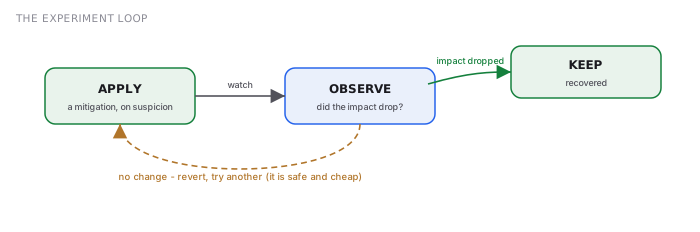
The idea rests on being honest about what you don't know during an incident: figuring out the root cause is slow and, under pressure, often wrong. Meanwhile a handful of reversible moves - drain the zone (stop sending it new traffic), roll back the deploy, fail over to another region, turn off the feature flag - clears up most incidents before anyone knows the cause. Once those moves are safe to try on a hunch, incident response stops being a race to diagnose and becomes a simple loop: apply a mitigation, watch what happens, then keep it or undo it.
When it applies
Tradeoffs
The same move, 3 ways
Every row is a production system that bet on this pattern — the note says how, in that system's own terms.
Often used together
Patterns sharing breakdowns with this one — derived from co-occurrence, threshold ≥2 shared.
Problems this pattern answers
The walls where its breakdowns live — each opens the cross-company comparison.