Pattern · seen in 3 breakdowns across 2 companies
Single-Writer Ownership
Let just one process write to each database (or shard), so that owner keeps everything it wrote in its own memory and never coordinates with other writers.
The mechanism
At its core: the usual design has many stateless servers share a database, so every write has to coordinate - locks, cache invalidation. Give each store one owner instead, and all of that collapses: it writes from its own memory with no one to coordinate with.
One owner per store means no locks and no cache invalidation - until the lease fails and two writers corrupt the data.
Definition
Give each store - a database, or one shard of one - a single owner: the only process allowed to write to it. Because nothing else writes, there is nothing to coordinate. The owner can hold everything it has written in its own memory and trust it completely, since no one else could have changed it. It can group and reorder writes however is fastest, and it only reads from the store to rebuild its memory after a crash. That flips the usual web-service shape, where a crowd of identical, stateless servers all share one database.
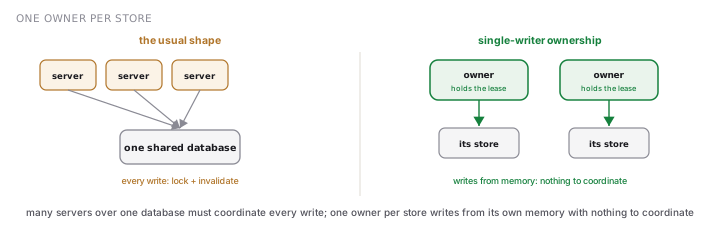
What makes this safe is a lease: a lock that one process holds by continually renewing it, and that expires if that process stops. Whoever holds the lease is the writer; everyone else stays out. The lease usually carries a version number, so if an old owner is slow and a new one takes over, the store can reject the stale owner's writes. This lease is the whole thing's correctness: if two processes ever believe they own the same store at once, both trust their own memory and quietly corrupt the data.
This pays off for a specific shape of workload: mostly writes, over a set of data small enough to fit in one process's memory, where the cost of coordinating between writers would otherwise be the main cost. At scale the data is usually split into many shards - as in application-layer sharding - and each shard gets its own single owner. It is worth being clear how this differs from electing a leader for availability. There, replicas choose a leader so the system keeps running when a node dies. Here, the single owner exists so the writer can skip coordination, and you accept that if an owner dies, its shard is down until a successor takes the lease and reads the state back from the store.
When it applies
Tradeoffs
The same move, 3 ways
Every row is a production system that bet on this pattern — the note says how, in that system's own terms.
Problems this pattern answers
The walls where its breakdowns live — each opens the cross-company comparison.