Pattern · seen in 2 breakdowns across 1 company
Distributed Metadata Model
A system's bookkeeping layer - the part that tracks where the data lives - can quietly limit how big the whole system can grow, so this pattern rebuilds it on a scalable database.
The mechanism
At its core: a system's real limit is often not its disks but its bookkeeping - the one component that tracks where everything lives. Move that bookkeeping onto a database built to scale, keep the actual data flowing straight to storage, and the ceiling lifts.
Add all the disks you want - if the bookkeeping that finds your data cannot grow, the system cannot either.
Definition
Every storage system has a bookkeeping layer - the record of what exists, who can touch it, and where each piece of data lives. Every operation checks it first. You have probably met one: a file system's name node, a database's catalog, or a coordination service like ZooKeeper. When that bookkeeping is a custom, fixed-size design - a single master machine, an index that fits in one process's memory - it quietly becomes the ceiling for the whole system. You can add rack after rack of storage, but it changes nothing once the part that locates the data cannot grow.
The fix is to stop hand-building that bookkeeping layer and rebuild it as an ordinary distributed service. The front-ends that handle lookups become stateless, so you can add as many as you need. The bookkeeping itself moves onto a database that is already built to scale out across many machines. The bookkeeping is now just a normal workload on a system built to grow, and the lookup service scales like any other stateless service.
One thing makes or breaks this: keep the actual data off the bookkeeping path. Clients ask the bookkeeping service only where the data lives, then read and write the bytes straight to the storage machines, without the data passing through the bookkeeping at all. That way the bookkeeping only limits how many operations per second you can do - never how many bytes per second - so adding storage machines adds bandwidth directly.
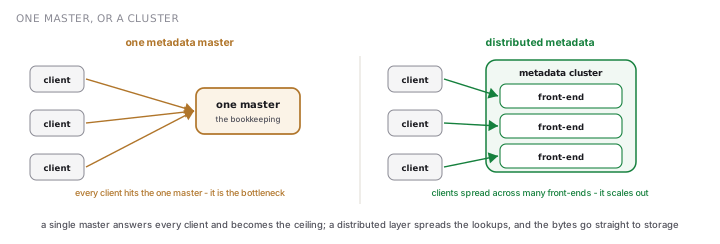
A couple of honest notes. The ceiling does not vanish, it moves: the system now scales until the underlying database does, so pick one whose limit is far away and is someone else's full-time job to raise. And this is a different move from splitting the data itself - patterns like application-layer sharding partition what each cluster holds, while this one rebuilds the bookkeeping about it. The two fit together, since a split-up data layer still needs a bookkeeping layer that scales.
When it applies
Tradeoffs
The same move, 2 ways
Every row is a production system that bet on this pattern — the note says how, in that system's own terms.
Often used together
Patterns sharing breakdowns with this one — derived from co-occurrence, threshold ≥2 shared.
Problems this pattern answers
The walls where its breakdowns live — each opens the cross-company comparison.