Pattern · seen in 2 breakdowns across 1 company
Shared-Pool Multiplexing
Giving each workload its own storage means paying for every peak separately, so create one shared storage pool where background work runs whenever the busy workloads are idle.
The mechanism
At its core: give every workload its own storage and it sits idle whenever it is not busy, which is most of the time. Pool them under one manager so a workload with sharp busy peaks and flexible background jobs share the same capacity, and the background jobs use whatever those peaks leave free.
Every silo is sized for its own peak, so it sits idle the rest of the time - pool them and background work fills the gaps.
Definition
Give each workload its own dedicated storage and you waste capacity by design. Each one has to be sized for its busiest moment, its peak. So every hour it is not busy - nights, weekends, any lull - is capacity you bought and are not using, and you pay that once for every workload.
The pattern creates one shared storage pool instead, run by one manager, holding two kinds of work that are busy at different times. One kind is user-facing and has to be fast; it gets very busy at peak hours and sits nearly idle the rest of the day. The other is background work with no deadline, which can run whenever there is spare room. You size the pool for the busy workload's peaks, and let the background work run in the time it leaves free. Each workload still feels like it has its own space, but that separation is now something the manager keeps up moment to moment, not a physical wall between separate machines.
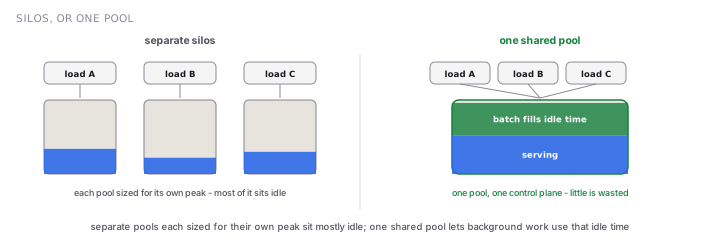
This works because the workloads are not all busy at the same time. So the pool only needs to be big enough for whatever is busy right now, which is far less than adding up every workload's peak. The background work quietly uses whatever is left over.
The price is that the workloads are no longer kept apart by the hardware itself. On separate machines they simply cannot touch each other; in one shared pool, the only thing keeping them apart is the manager, doing its job every moment. When that enforcement slips, one workload eats into another's capacity - a noisy-neighbor incident between workloads that were never meant to touch. This is a different move from a load-bearing cache, where a speed-up layer slowly turned into capacity by accident; here you pool capacity on purpose, to use the spare room no single workload needs all the time.
When it applies
Tradeoffs
The same move, 2 ways
Every row is a production system that bet on this pattern — the note says how, in that system's own terms.
Often used together
Patterns sharing breakdowns with this one — derived from co-occurrence, threshold ≥2 shared.
Problems this pattern answers
The walls where its breakdowns live — each opens the cross-company comparison.